

Fig 1. Cover art by Jane Chapman for Bear Says Thanks by Karma Wilson, Margaret K. McElderry Books, 2012, Front cover.
Length: 40 pages
Sometimes trying to choose a book for your child can be difficult. When picking out books, many of us want to find a book that is developmentally appropriate for our kiddo(s). However, choosing a book that is not overly complex yet not too simplistic can feel like a daunting task. Of course, we also want our child to remain engaged throughout the book and for them to demonstrate an interest in reading it through until the end. That is why I chose to add the book Bear Says Thanks by Karma Wilson to my personal “SLP Library” collection. I found this book to be a “happy medium” across multiple age-levels. There are a number of speech and language skills that can be targeted while reading this book. This makes it a great addition for my younger kiddos, but also for some of my older students, as well. Plus, this book is a wonderful addition for incorporating seasonal storybook themes!
Here are some possible skills to target while incorporating this story:
Answering Wh-questions: Ask children various Wh-? Questions about scenes from the story (i.e. “Where does this story take place?”, or “Who is bored and misses their friends?” etc.).
Asking/formulating yes/no and Wh-questions: Encourage children to come up with questions of their own about scenes/pictures in the story (i.e. After looking at the pictures, I might ask “Can you come up with any questions about the pictures or the story?”, etc.).
Identifying rhyming words to promote Phonological Awareness skills: After reading a page containing rhyming words, instruct children to find the words that sound the same at the end (rhyme) (i.e. “…and they both see Hare with a big batch of muffins at the door of the lair.” Ask children, “Can you find which words rhyme?” “Both hare and lair have the same sounds at the end. Hare and lair both rhyme!”
Inferencing: Asking children open-ended questions about clues provided in the story or previous background knowledge (i.e. “Look at the brown and orange leaves around, what season do you think it is?” etc.).
Combining words to expand upon utterances: Model 2–3-word utterances for children to imitate (i.e. “I see…brown bear)”, “hopping hare”, etc.).
Promoting joint attention skills: While reading, instruct children to point to pictures of various animals, foods, characters, etc.).
Incorporating the book with an AAC system: Model functional nouns and vocabulary words using an Augmentative Alternative Communication (AAC) system (i.e. “Look, the bear wants to make dinner. Let’s practice navigating to actions and foods using our AAC system to say, “make dinner”, etc.).
Context clues: Demonstrate how clues embedded within the sentence or page can help define what an unfamiliar vocabulary word means (i.e. “Brrrrr! says Badger as he tromps inside.” What do you think the word “tromps” means? etc.).
Conversational turn-taking: Ask questions that facilitate back and forth statements and responses (i.e. “When I’m hungry, I like to eat ____. “What do you like to eat when you’re really hungry?” etc.).
Identifying emotions: While reading the book, ask children how they think that each particular character feels in each scene (i.e. “How does bear feel when he finds out that he has no food for his friends to eat?” Or “How do you think bear’s friends feel when he doesn’t have any food to share with them?” etc.).
Sequencing and story retell: After reading the story, practice retelling the key parts using sequencing words (i.e., “First, mouse stops by with ____. Next, Hare came over with ____.”, etc.).
Targeting a wide variety of articulation of speech targets/goals: (i.e. early and later developing speech sounds, etc.).
References:
Wilson, K. (2012). Bear Says Thanks. (J. Chapman, Illus.) Margaret K. McElderry Books.
-Meredith Valk M.S. CCC-SLP
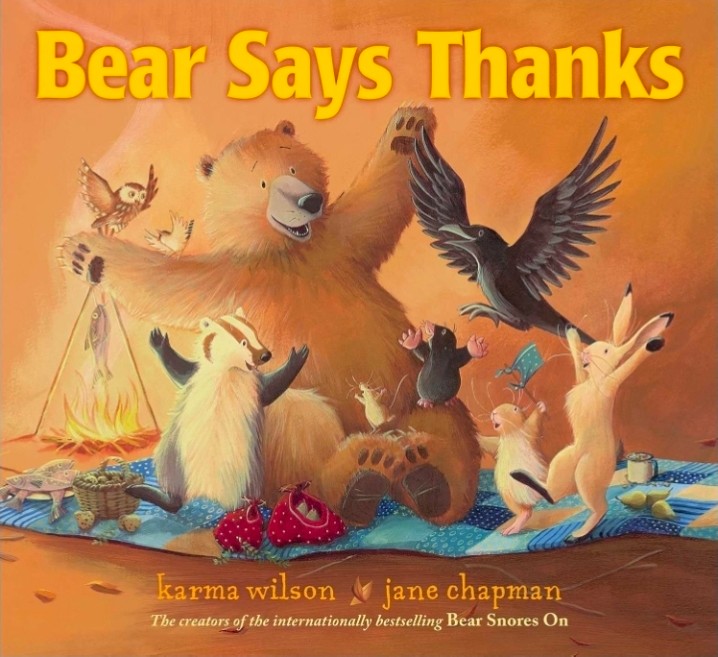
Fig 1. Cover art by Jane Chapman for Bear Says Thanks by Karma Wilson, Margaret K. McElderry Books, 2012, Front cover.
Length: 40 pages
Sometimes trying to choose a book for your child can be difficult. When picking out books, many of us want to find a book that is developmentally appropriate for our kiddo(s). However, choosing a book that is not overly complex yet not too simplistic can feel like a daunting task. Of course, we also want our child to remain engaged throughout the book and for them to demonstrate an interest in reading it through until the end. That is why I chose to add the book Bear Says Thanks by Karma Wilson to my personal “SLP Library” collection. I found this book to be a “happy medium” across multiple age-levels. There are a number of speech and language skills that can be targeted while reading this book. This makes it a great addition for my younger kiddos, but also for some of my older students, as well. Plus, this book is a wonderful addition for incorporating seasonal storybook themes!
Here are some possible skills to target while incorporating this story:
Answering Wh-questions: Ask children various Wh-? Questions about scenes from the story (i.e. “Where does this story take place?”, or “Who is bored and misses their friends?” etc.).
Asking/formulating yes/no and Wh-questions: Encourage children to come up with questions of their own about scenes/pictures in the story (i.e. After looking at the pictures, I might ask “Can you come up with any questions about the pictures or the story?”, etc.).
Identifying rhyming words to promote Phonological Awareness skills: After reading a page containing rhyming words, instruct children to find the words that sound the same at the end (rhyme) (i.e. “…and they both see Hare with a big batch of muffins at the door of the lair.” Ask children, “Can you find which words rhyme?” “Both hare and lair have the same sounds at the end. Hare and lair both rhyme!”
Inferencing: Asking children open-ended questions about clues provided in the story or previous background knowledge (i.e. “Look at the brown and orange leaves around, what season do you think it is?” etc.).
Combining words to expand upon utterances: Model 2–3-word utterances for children to imitate (i.e. “I see…brown bear)”, “hopping hare”, etc.).
Promoting joint attention skills: While reading, instruct children to point to pictures of various animals, foods, characters, etc.).
Incorporating the book with an AAC system: Model functional nouns and vocabulary words using an Augmentative Alternative Communication (AAC) system (i.e. “Look, the bear wants to make dinner. Let’s practice navigating to actions and foods using our AAC system to say, “make dinner”, etc.).
Context clues: Demonstrate how clues embedded within the sentence or page can help define what an unfamiliar vocabulary word means (i.e. “Brrrrr! says Badger as he tromps inside.” What do you think the word “tromps” means? etc.).
Conversational turn-taking: Ask questions that facilitate back and forth statements and responses (i.e. “When I’m hungry, I like to eat ____. “What do you like to eat when you’re really hungry?” etc.).
Identifying emotions: While reading the book, ask children how they think that each particular character feels in each scene (i.e. “How does bear feel when he finds out that he has no food for his friends to eat?” Or “How do you think bear’s friends feel when he doesn’t have any food to share with them?” etc.).
Sequencing and story retell: After reading the story, practice retelling the key parts using sequencing words (i.e., “First, mouse stops by with ____. Next, Hare came over with ____.”, etc.).
Targeting a wide variety of articulation of speech targets/goals: (i.e. early and later developing speech sounds, etc.).
References:
Wilson, K. (2012). Bear Says Thanks. (J. Chapman, Illus.) Margaret K. McElderry Books.
-Meredith Valk M.S. CCC-SLP