Date
Share
Communication looks different for everyone. While this sentiment may feel like it gets stated often, especially in the SLP community, it is still resoundingly true. A student that I see for therapy has begun to show more interest in communicating with her AAC (augmentative alternative communication) speech-generating device. This has been an encouragement and a motivator for myself as the speech-language pathologist to continue investing care and time into programming her device and modeling it for language use. We all are aware that good things take time, especially when it comes to AAC. We have spent several weeks together using the device for different purposes, such as socialization, requesting, describing, and communication breakdowns. Sometimes it can feel like—because progress may seem slow—things aren't happening, but with our students, they are constantly taking in so many different things, including our modeling for AAC.
This week, we began our therapy session as we normally do. I casually stated, "Let's see if I can find some fall books for October that we can read!" Independently, I heard my student activate a button on her AAC. She navigated from her home screen of core buttons to the reading/books topic page set. Without prompting, she located the phrase, "I want a new book to read." Following this, she was able to pick the book that she wanted, make comments about the animals pictured in the book, and state her feelings about the book afterward. It was an incredibly rewarding session to see how powerful AAC can be to promote a way to communicate functionally and allow our students to be heard!
-Hannah Collie M.S., CCC-SLP
Date
Share
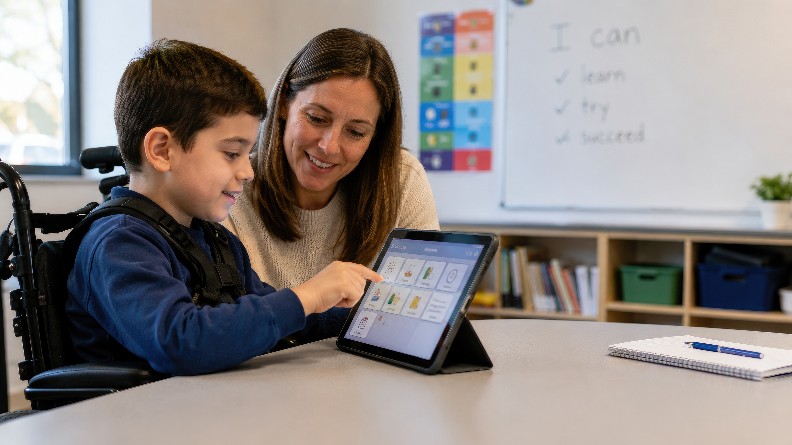
Communication looks different for everyone. While this sentiment may feel like it gets stated often, especially in the SLP community, it is still resoundingly true. A student that I see for therapy has begun to show more interest in communicating with her AAC (augmentative alternative communication) speech-generating device. This has been an encouragement and a motivator for myself as the speech-language pathologist to continue investing care and time into programming her device and modeling it for language use. We all are aware that good things take time, especially when it comes to AAC. We have spent several weeks together using the device for different purposes, such as socialization, requesting, describing, and communication breakdowns. Sometimes it can feel like—because progress may seem slow—things aren't happening, but with our students, they are constantly taking in so many different things, including our modeling for AAC.
This week, we began our therapy session as we normally do. I casually stated, "Let's see if I can find some fall books for October that we can read!" Independently, I heard my student activate a button on her AAC. She navigated from her home screen of core buttons to the reading/books topic page set. Without prompting, she located the phrase, "I want a new book to read." Following this, she was able to pick the book that she wanted, make comments about the animals pictured in the book, and state her feelings about the book afterward. It was an incredibly rewarding session to see how powerful AAC can be to promote a way to communicate functionally and allow our students to be heard!
-Hannah Collie M.S., CCC-SLP