
Avoiding End-of-Year Burnout: Tips for School-Based SLPs As the end of the school year approaches, many school-based SLPs find themselves navigating a perfect storm: standardized testing, rising student behaviors, and shifting schedules. This time of year can be overwhelming—not just for students and teachers, but for SLPs too. Burnout can sneak in when we're trying to give our best while running on empty. Here are some practical ways to avoid burnout and revitalize your therapy sessions so your students continue to receive the best care—even in the home stretch. 1. Refresh Your Therapy Goals Now’s a great time to shake things up. Instead of sticking to the same weekly routine, consider focusing on: Functional, real-world communication skills like asking for help, making plans, or resolving conflicts. Generalization and carryover , helping students apply mastered skills in other settings (e.g., practicing speech strategies they’ll need for summer activities). These goal shifts make sessions feel more purposeful and relevant to students' daily lives. 2. Introduce New, Engaging Materials Newness helps both you and your students stay motivated. Try: Seasonal themes like summer, nature, or travel. Creative tasks like designing a dream vacation, making a mini-book, or role-playing scenarios. Interactive games like scavenger hunts, board games, or movement-based tasks that get kids up and out of their chairs. Choice boards where students pick their own activity—it gives them ownership and boosts participation. Even one fresh idea per session can make a difference in energy and engagement. 3. Switch Up Your Therapy Approach Working one-on-one gives you the flexibility to individualize like a pro. If sessions have felt repetitive, try: Movement-based activities (think: hallway vocabulary hunts or speech stations). Narrative-based therapy using student-led stories or comic strips to target multiple goals. Student-led sessions where they help plan the activity around their goals—great for older or more independent students. This kind of creativity can re-energize you just as much as it helps your students. 4. Simplify Your Planning and Tracking End-of-year doesn't mean over-the-top. Use quick-prep activities, repeat adaptable tasks across students, and lean on visuals or checklists to track progress efficiently. Less planning time = more breathing room for you. Give yourself permission to let go of perfection—you’re still making a difference. 5. Make Time for Yourself—Even Briefly Burnout isn’t just about the workload—it’s about the lack of restoration. Take mini-breaks, step outside between sessions, or play your favorite playlist during documentation. Little moments of calm add up. Burnout doesn’t come from just doing too much—it comes from doing too much without rest. 6. Reconnect with Your Why In the chaos of testing and transitions, don’t lose sight of your impact. You’re helping kids connect, express themselves, and build skills that will last long after the school year ends. That matters—every single session. It’s easy to feel like a scheduling machine this time of year. Pause and remind yourself why you’re here: to help students find their voice, feel confident, and connect with the world. That mission hasn’t changed, and you’re doing important work—even when it’s messy. You don’t have to overhaul your entire caseload to finish strong. A few thoughtful shifts can keep you (and your students) energized all the way to summer. Hanna Webb, M.S., CF-SLP References: American Speech-Language-Hearing Association. (n.d.-i).Tackling burnout in the school setting: Practical tips for school-based speech-language pathologists.https://pubs.asha.org/doi/10.1044/2021_PERSP-20-00262 Scruggs, C. (2021). Avoiding burnout as a school-based SLP. The Speech Bubble SLP. https://www.thespeechbubbleslp.com/2021/04/avoiding-burnout-as-a-school-based-slp.html Wright, S. (2020). Staying motivated: Tips for re-energizing your therapy sessions. The Speech Space Podcast. https://www.speechandlanguagekids.com

Fig 1. Cover art by Helen Oxenbury for We’re Going on a Bear Hunt by Michael Rosen, Walker Books, 1993, Front cover. Length: 40 pages Another one of my personal favorites from my own “SLP Library” of books is We’re Going on a Bear Hunt by Michael Rosen. This book is especially versatile, as you can incorporate it into therapy sessions or story time at home with both younger and older children, as well. This book appeals to audiences for its sensory-rich experience, predictable patterns with words/phrases, and usefulness in targeting a plethora of speech and language skills. Here are some possible skills to target while incorporating this story: Inferencing: Asking children open-ended questions about clues provided in the story or previous background knowledge (i.e. “What do you think they will find?” or “What do you think will happen next?”, etc.); Object attributes: Ask children specific questions about item descriptors or appearance (i.e. “How do you know that it’s mud?” You can talk about color, size, shape, location, parts, function, category, etc.; Answering Wh-questions : Ask children various Wh-? Questions about scenes from the story (i.e. “ What do the characters expect to find?, ” Where are they going now?”, “ Why did the characters go and hide there?”, etc.). Asking/formulating yes/no and Wh-questions : Encourage children to come up with questions of their own about scenes/pictures in the story (i.e. After looking at the picture, I might ask “What other animals might be in the woods?”, etc.). Sequencing : After reading the story, practice retelling the key parts using sequencing words (i.e. “ First , the characters went through the ____. Next , they traveled through the ____.”, etc.). Spatial concepts : Emphasize prepositions, and vocabulary words that describe location: “You can’t go over it. You can’t go under it…” (i.e. “Show me “over”, etc.). Using expressive language skills for the purpose of commenting (i.e. “Can you think of anything else that might “squelch” if you touch it or step in it?” “Slime also makes a squelch sound when you play with it”, etc.); Combining words to expand upon utterances : Model 2-3 word utterances for children to imitate (i.e. “squishy mud”, “dark cave”, etc.); Promoting joint attention skills : While reading, instruct children to point to pictures of various animals, places, characters, etc.); Incorporating the book with an AAC system : Model functional nouns and vocabulary words using an Augmentative Alternative Communication (AAC) system (i.e. “Let’s find a bear using our AAC system”, etc.). Pairing the actions in the story with tactile/kinesthetic movement (i.e. “Tiptoe, tiptoe”, “Show me how you would tiptoe through the cave”; “Back through the river! Splash, splash!” “Show me how you would swim through the river”, etc.); Conversational turn-taking : Ask questions that facilitate back and forth statements and responses (i.e. “How would going on a bear hunt make you feel?” Have you ever heard the sound that mud makes?”, etc.); Targeting a wide variety of articulation of speech targets/goals (i.e. early and later developing speech sounds, etc.); There are so many ways to get creative while using this book to promote increased language skills, and to practice articulation of speech targets. References: Rosen, M.W. (1993). We’re Going on a Bear Hunt. (H. Oxenbury, Illus.) Walker Books. Meredith Valk M.S., CCC-SLP
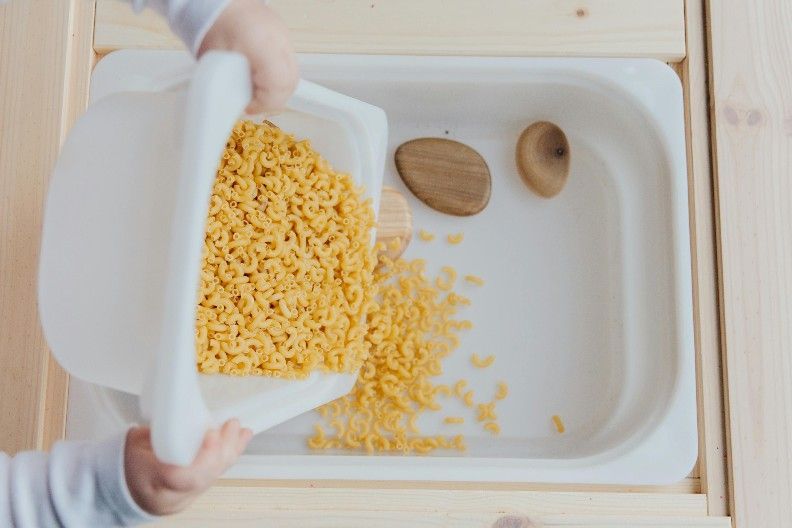
Sensory bins are often regarded highly for developing a child's fine motor skills, but in speech therapy, they can also be a very effective tool for targeting a variety of goals. Utilizing sensory bins help to transform structured tasks into engaging, hands-on play that incorporates a child’s need for movement and tactile input. They can serve as a grounding tool, helping students feel calm and regulated. When a child’s body is regulated, their willingness and ability to communicate often improves. Rather than asking students to sit and perform drills, sensory play invites language through shared experience, play and exploration. Why Sensory Bins Work in Speech Therapy Sensory bins transform structured activities into play that incorporates a child's kinesthetics. It is a fabulous grounding technique to allow students to feel calm and supported. When bodies find this sense of regulation, willingness to communicate can increase. Sensory bins are especially useful for students who struggle with anxiety, attention, and regulation. Sensory play creates natural opportunities for: Commenting and labeling Requesting and turn-taking Following directions Problem-solving and joint attention Speech & Language Goals You Can Target One of the biggest strengths of sensory bins is their flexibility. With a little guidance from the clinician, they can support a wide range of goals, including: Expressive language (expanding utterances, answering questions) Receptive language (directions, basic concepts) Pragmatics (shared attention, social commenting) Articulation (sound-loaded objects and repeated target words) AAC use (core vocabulary like more, help, open, in, out) The materials stay the same, but the targets can be fluid. How to Build a Sensory Bin (Without Overthinking It) You don’t need anything elaborate. Start with: One base material (rice, beans, kinetic sand, clay, cotton balls, shredded paper) A small set of manipulatives tied to your goals (animals, vehicles, letters, picture cards, and even target words for articulation) Consider which children may be oral seekers, and avoid using unsafe items that could be placed in the mouth. Before the session, ask yourself: What language do I want to model? What sounds might this student be working on? How will the student interact with the materials? During play, narrate what’s happening, model simple language, expand student attempts, and give plenty of wait time. Follow the student’s lead while gently guiding the interaction toward your goals. Simple Tools, Powerful Language Sensory bins don’t need to be extensive or time-consuming to be effective. When used intentionally, they create a calm, engaging space where communication feels safe and meaningful. They aren’t about keeping students busy; they’re about creating the right conditions for language to grow. Consider using these fun tips to elevate speech and language treatment for sensory engagement! Hannah Collie M.S., CCC-SLP